
5 min read
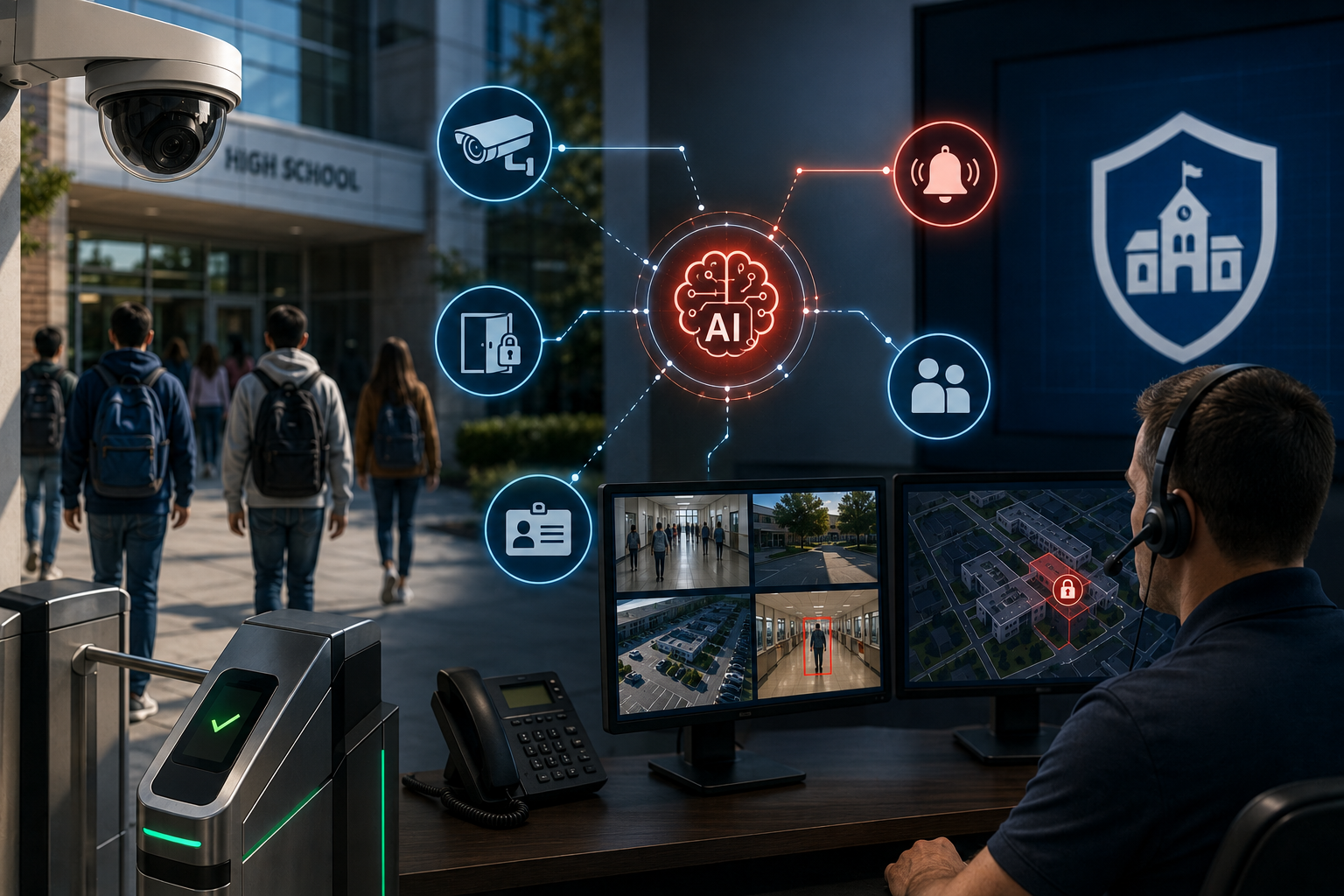
For two decades, school security meant cameras that recorded and alarms that sounded. Agentic AI changes the question from "what happened?" to "what should happen next, right now?" Here is what is real, what is overstated, and how to build it responsibly.
Walk into most schools today and the security technology you will find is fundamentally reactive. Cameras record footage that gets reviewed after an incident. Alarms sound once a door is already breached. Metal detectors create bottlenecks at the entrance and depend entirely on the staff member standing beside them. Each of these tools is useful, but they share a common limitation: they capture or signal an event, then wait for a human to interpret it and decide what to do. In a fast-moving incident, those seconds of interpretation are the most expensive seconds there are.
"AI" in physical security has, until recently, meant something narrower than the headlines suggest. A computer-vision model that flags a visible firearm or an unattended bag is doing perception, and doing it well is genuinely valuable. But perception alone still hands the problem back to a person. The shift now underway, and the reason "agentic AI" has become the term of the year, is the move from systems that detect to systems that detect, reason, and coordinate a response.
01 What "agentic" actually means
In the AI field, an "agent" is a system that does more than answer a single question. It perceives its environment, plans across multiple steps, draws on memory and context, uses tools to act, and operates with a degree of autonomy. Applied to a campus, that is the difference between a camera that says "possible weapon detected on Camera 14" and a security platform that recognizes the threat, checks it against other sensors to confirm it is real, identifies which building and which entrance, locks the relevant doors, pushes a targeted alert to staff and to dispatch, and follows the person across adjacent cameras while it does all of it.
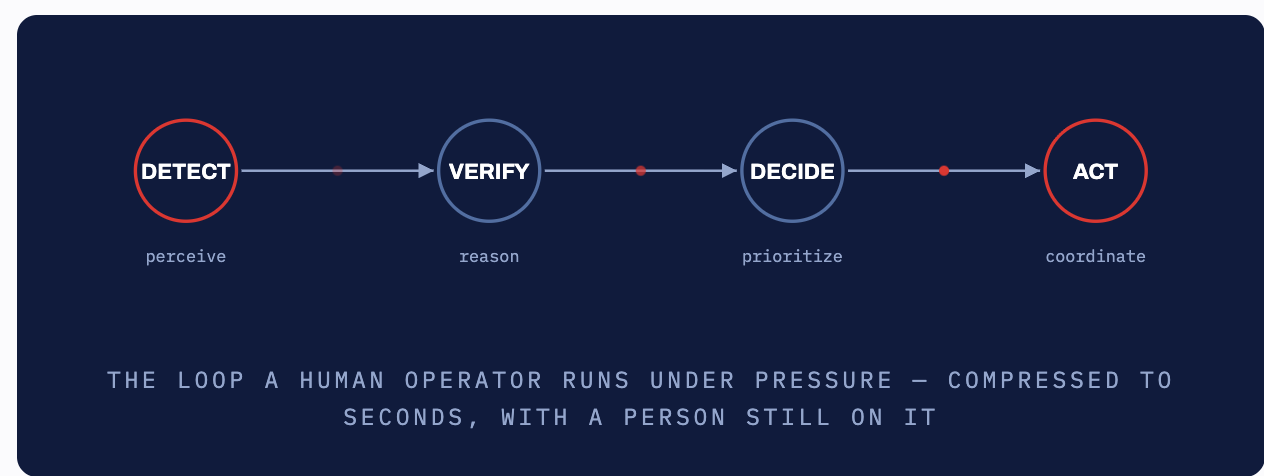
The key word in that last sentence is compressed, not removed. The honest framing of agentic AI in a school setting is not a system that pulls the trigger on lockdown by itself with no oversight. It is a system that does the slow, error-prone parts of the response loop, gathering, correlating, and prioritizing, fast enough that the human who confirms the decision is working from a clear picture instead of a wall of raw alarms.
02 What it looks like on a real campus
No single product delivers this. Agentic threat detection is an outcome of several specialized layers designed to work together. The integration is the hard part, and it is where most deployments succeed or fail.
- ENTRY
Weapons screening at the door
A new generation of walk-through screening replaces the old metal detector. Instead of alarming on every set of keys, these systems use layered sensing and AI to distinguish a benign object from a weapon of mass harm, and they let large numbers of students pass without the bottleneck and the prison-yard feel. - PERIMETER
Visual weapon and behavior detection
AI turns existing surveillance cameras into a layer that watches in real time, flagging a brandished firearm, a person carrying a rifle across the parking lot, or escalating aggression, often before a weapon is ever inside the building. Well-tuned systems now distinguish a holstered weapon from a drawn one and report false-alarm rates as low as roughly one in two thousand passes. - CONTROL
Access control and lockdown
The detection layer means nothing if it cannot act. Tied into the access-control system, a confirmed threat can trigger targeted lockdown, sealing a wing or a building, while keeping mechanical egress intact for the people inside. - RESPONSE
Mass notification and dispatch
The same event drives clear, location-specific instructions to staff, to building paging and digital signage, and to law enforcement, with live video and the suspect's last-seen location attached rather than a 911 call placed from memory under stress. - ACCESS
Visitor management
Front-of-house screening that checks visitors against watch lists and issues credentials closes the most common entry gap, and feeds the same platform that everything else runs on.
The "agentic" character does not come from any one of these boxes. It comes from a unifying platform that can take the signal from the perimeter camera, correlate it with the door it is near, weigh it against context, and orchestrate the entry, control, and response layers as one coordinated action. That orchestration layer, platforms such as Ambient.ai on the video-intelligence side, is where the field is moving fastest.
03 The part the brochures skip
Anyone selling you certainty about this technology is overselling it. The responsible position, and the one we take with every school we work with, is that agentic AI is a powerful layer in a strategy, not a strategy by itself.
The January 2025 shooting at Antioch High School in Nashville, where an AI weapons-detection system was in use, has driven an ongoing, legitimate debate about what these tools can and cannot do. Detection depends on camera coverage, sightlines, lighting, and whether a weapon is ever visible to a lens. A system is only as good as the design and the procedures wrapped around it.
Three things separate a deployment that earns its budget from one that becomes shelfware:
False positives are the real enemy. A system that cries wolf gets ignored, and an ignored system is worse than none. Accuracy and a low false-alarm rate matter more than the length of the feature list, which is why a focused, well-tuned detection capability usually outperforms a platform that claims to detect everything.
Keep a person on the loop. Automation should compress the response, not own it. The decisions that lock a building or call in law enforcement should be confirmed by a human working from a clear, AI-assembled picture. That is both safer and far more defensible after the fact.
Privacy and proportionality are design inputs, not afterthoughts. Schools have to balance protection against the right of students to learn somewhere that does not feel like a checkpoint. What a system watches for, what it stores, who can see it, and for how long are decisions to make deliberately, in the open, and in writing.
04 The funding and compliance picture
The case for acting now is not only about capability. It is increasingly written into law and into grant money.
Two compliance threads matter for any school weighing this investment. The first is NDAA compliance: federally funded projects, and a growing list of state and institutional buyers, require surveillance and access hardware that is free of prohibited manufacturers. The second is grant eligibility. Faith-based and nonprofit schools in particular should be looking hard at the Nonprofit Security Grant Program (NSGP), which can fund a substantial share of exactly this kind of work, when the system is specified to be eligible from the start. Specifying for these requirements after the fact is expensive. Specifying for them on day one is free.
05 Where SmartConnect fits
We are a Los Angeles security systems integrator, not a single-product vendor, and that is the point. The value in agentic threat detection lives in how the screening, video, access control, notification, and visitor-management layers are chosen and wired into one coherent system, with NDAA-compliant hardware and grant eligibility built in from the design phase. We carry the platforms that lead this category, and we will tell you plainly where the technology is strong and where it still needs a human.
Start with an honest assessment, not a sales pitch
We offer schools a complimentary security site assessment: a clear-eyed gap analysis of your current coverage, your highest-leverage upgrades, and where NSGP or other grant funding can carry the cost. No obligation, and no pressure to buy a thing you do not need.